Showing posts with label Afrofuture. Show all posts

Monday, November 3, 2014

Kaizen Update


We are pleased to announce the revised update of our editing and writing analysis software tool: Kaizenmoto. The Kaizen text analysis web-app is up at our mother site, in the code section:  http://www.moorsgatemedia.com/code/kai/index.html It is still a bit slow, but it works well.
 
The goal of the app is to help you in the editing process. See what your average sentence lengths clocks in at. We find that what is needed most in the editing process is a way to quantify styles. Is your dialogue to prose ratio in line with the style you are after (hint, first person ratios are different than third person ones).  Check out your sentence starters, reading complexity, reading time, word count Coleman reading score, and a bunch more metrics. 

Check back often, we are updating and optimizing as we go, but it is publish or perish right. 

[editing software, fiction writing software, word editing, readability software]

Moorsgate Media

Tuesday, September 2, 2014

Chaos Classifieds II

Attention surfers of the Internet:

Deep within the bowels of the Internet, past decrepit Geo-Cities  archives; below Live Journal post regarding your unwavering love for Hansen; tucked in a forgotten corner of a low-baud rate server, there exists a lively classifieds bulletin board.

However, this is no ordinary "missed connections", "soiled futon " market place. This is market for wonders, for forbidden objects found where brave men fear to tread. It is a market for outdated technological marvels, arcane works, eldritch objects from beyond the borders of the ordinary.

The denizens of these boards engage in a brisk trade, seeking to acquire or unload nameless horrors, insane robots from a nightmarish future, hire teams of blind ninja assassins, or just adopt a couple of genetic monstrosities.

The Moorsgate Media Twitter feed occasionally retweets requests that come across our desk. Below is just a taste of the terrifying and degenerate ads that populate these boards. Re-tweets are not endorsements.


Needed: wealth management professional specializing in immortality. Looking for long term relationship .

Needed: user manual for oblivion class doomsday device. #chaosclassified

Needed: #API documentation for Necronomicon. Unable to force quit hell portal generator in IE6. Concerned. #chaosclassified #SciFi #html5

Sale: cognitive enhancement device, side effects; increase in baseline #evil Instruction manual and box included.

Previous ads can be found here:
http://moorsgatemedia.blogspot.com/2014/01/chaos-classified.html

Monday, August 18, 2014

[ssf] Dr. Jergen's Device


______________________________________________________________________________
To: HRJergen@[redacted].[redacted]
From: [Redacted]
CC: [Redacted]

Dear Dr. Jergen,

We are patent attorneys retained by the Corporation for the purposes of securing protection on any intellectual property developed by employees and ensuring that such intellectual property is properly assigned to the Corporation and recorded as a corporate asset.

We were recently asked by Chief Counsel [Redacted] to evaluate the likelihood of receiving patent protection on your "entity retention device", cover sheet above.  

We have been made aware of the circumstances surrounding the development and intended use(s) of such a device and have evaluated it with that information in hand.

Let us be the first to say that we appreciate that the device development timeline was necessarily shortened due to [Redacted], and the design and implementation decisions made were under truly harrowing circumstances. 

We also appreciate that the end result was highly successful in assisting in the resolution of  [Redacted]. However, we do not believe your invention will pass muster at the Patent Office for number reasons.

Principally, the "mechanisms of operation" of your invention are not explicitly described nor fully explicable given generally agreed upon natural and scientific laws. 

Furthermore, certain subsystems (denoted in the various annotated scripts ) of your invention operate using substances that are not readily available, or have attendant ethical challenges that make duplication or acquisition by persons outside the Company, unlikely.  

It should be noted that the Patent Office could evaluate such extraordinary claims, if demonstrable evidence were provided. 

Technically, we are in possession of such evidence, in the form of video footage from the most recent event which highlights the use of the device in sequestering and transporting [Redacted]. However, knowledge of [Redacted] is a closely guarded corporate trade secret. We are under professional, ethical and contractual obligations to not to disclose the nature of these circumstances to the public.   As you were well aware, the consequences for failing to adhere to these edicts are significant

As such, we would only have your unverified statements in support of a patent. Therefore, we have advised the General Counsel to not proceed and to close this file. 


Please do not view our decisions as minimizing the effort you put towards resolving [Redacted]. We look forward to working with you and your team in the future on the [Redacted] project, which we believe to be quite lucrative and impressive technological development. 


 Your Truly, 

Tuesday, June 10, 2014

On Criticism


The Art of Thinking Clearly by Rolf Dobelli. .
Recently, there has been an uptick in discussions about benefit of diverse characters in fiction. For example, see here .

Sound arguments for a more inclusive universe of fiction are legion.  There exits, beyond the compelling arguments about diversity of subject, arguments to be made about diversity of authorship.

Obviously, a talented writer of any background, can tell a gripping story about a culture different for her own. However, is something lost in experiential translation when the rich and comfortable tells stories of the poor and oppressed?  Should we assume that the meritocracy of talent operates with an invisible hand and just hope that the privileged operate in a world without blinders?

We could debate this topic for years and never get to a satisfactory resolution. Instead, the issue raises an interesting thought experiment about the usefulness of criticism. Specifically, what obligation does a critical consumer of fiction have as its creator? Do consumers of media featuring or authored by POCs have an obligation to view the work with a less critical eye, least they discourage the telling these stories? (This isn't necessarily a question grammar, structure and pacing, but one of reason, weight and intent.)  

Or should those tales featuring the least represented carry the dual weight of being entertaining and profound? If they don't, have they failed in some respect.  Is it not enough to tell a good, fun story? Does it need to shatter preconceptions, subvert tropes, and open minds?  Can POC fiction ever exist outside of itself, telling tales of pulpy mages and wisecracking aliens, without the necessity to parse the hidden meaning, the social commentary of a people's agenda.

It is often true that POC are judged twice as harsh (illumination here) when it comes to critical analysis of their work,  is this the same standard that must be applied to works that feature their likenesses?

Do reviewers have to look at a work and demand it be something that it isn't? Of course, the one argument is that there are so very few works that feature POCs, anyone who undertakes the effort should be given the benefit of the doubt. We shouldn't demand that works be complete realizations of social commentary mixed in with compelling narratives. Sometimes, it is okay to not require sub-text with our text. On the other, literary gatekeepers can and do demand certain shibboleths to be tackled when POCs feature heavily in the plot synopsis or author page. Recognition, even when bounded by expectations, can solve problems of access. Should a reviewer stand in the stead of the literary community and demand that every self-published vampire vs robot novel also speak to the eternal existential struggle for justice and equality?

Our thoughts are mixed. The role of criticism to should be to lift all boats; each review challenging the author to rise and make his colleagues rise.  But criticism also should function as an iceberg to the hull of ego. Shouting that you are tackling hard issues does not give you a waiver to actually tackle them. Voices need to be heard, and be heard well.

Moorsgate Media


Friday, March 7, 2014

The First Person Narrative

An increasingly common style in fiction, and self published fiction in particular,  is the use of the first person voice. Stylistically, there is nothing wrong with the first person voice. Well executed, it has been used to great effect in commercially and critically acclaimed novels from Jane Eyre to The Hunger Games.

However, encountering a narrative that begins and ends with a single view point tends to telegraph that there is a limit to the scope of the world that has been crafted. Crafting a story in a rich, detailed world is possible in the first person narrative (again See Hunger Games). However, the scope of that world will always be limited to places that the character has personally experienced.  Everything else, exposition, news, conversations with travelers, all of it is unreliable. Third Person narratives overcomes this limitation by usually establishing a number of view points that breathe life into various facets of their world.

Compare the universe of The Culture Novels or Game of Thrones to the world of Twilight or The Hunger Games. The former layers the individual stories and thoughts of multiple characters into the narrative tapestry. The latter, while telling compelling stories in their own right, rest on a foundation that the primary character is the most important person in this world. In the latter, the narrator (and your) view is given prominence over all others. We are left with second hand dialogue, with possible unreliable news or information, to gain insight into the motivations of others and the contours of their world. Events that occur outside your view are never as important as things you see.  For example, do we know the true motivations of the other characters in Twilight.  Do we know the true motivations of the residents of the Capital in Hunger Games? Do we care? 

More important than simply wishing to hear a different voice; the first person set up an uncomfortable divorce from a diversity of view points. The authors of first person stories typically have a significant overlap with their characters. That makes them easier and interesting to write for the author, but doesn't explore how others experience the same world. What results are stories about members of the racial and economic Majority, encountering a world that is an escape from the bland monotony of their comfort. Of course, most readers are reading from a position of comfort so the match is a fair one.

But in matching the audience to primary point of view, it becomes easy for an author to wipe away the lack of diverse characters in their books. By focusing squarely on a character that the author relates physically, emotionally and economically, they are tacitly arguing that the story can be told without anyone else's thoughts.  When you only have one voice, it is easy to argue that it should reflect you the author. Diversity then becomes a simple matter if sprinkling your world with some different characters for your character to interact.

The core problem is that you avoid is putting yourself in the role of a character that is different. Fiction at its highest skill involves transporting us to other worlds, but also to other people. The readers lose something if you close the world down to only one view point, one that is a slight variation of their own. Good fiction allows the reader to find themselves in the characters, not only temperamentally, but also physically, emotionally, sexually. If you are truly crafting a new world, then it should be big enough for more than one person's thoughts.

Moorsgate Media
    

Monday, November 11, 2013

Inter-racial relationships mean disaster!

The recent election for mayor of New York City was remarkable for a number of reasons. For one, it was an election where the right to "Sext" became a front page issue. More importantly, it was an election where one candidate was running for mayor is married to a woman of a different race, and no one made a big deal about that relationship. In fact, most political observers believe that the Mayor-Elect owes much of his success TO his bi-racial family.

One of the ways that science fiction has sought to portray "the future" is through the use of non-typical character positions and relationships. This is a polite way of saying "you know it is the future because of X", where X could be anything that would't happen today ( i.e. Black President, to well....female president). Basically, any time (prior to 2008 ) you saw a non-white, non-male president, chances were that you were dealing with some sort of speculative fiction. See Freeman, Morgan;

Another tip off to the fact that you were dealing with dire straits was the taboo of interracial relationships.

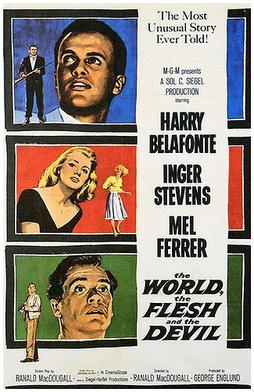
Anti-miscegenation laws were still on the books in southern states until 1967. However, even when certain relationships were illegal, science fiction authors used them to demonstrate either the scope of the catastrophic fall of humanity, or the blinding pace of "otherness" of the future. The 1959 film, The World, the Flesh and the Devil, explores this premise with  a sort of rye humor one expects from a sci-fi film starring Harry Belafonte.  In it, Belafonte plays Ralph an educated, technical savvy individual who spends most of his post-apocalyptic free time avoiding the sexual advances of Inger Stevens [ed: What ?]. The movie sets the audience up with an "unusual" tale, but keeps the action from getting into pearl clutching territory (remember it is 1959).

By the 1970's, audiences were more tolerant of interactive relationships taking the next step. As shown in the opening image, 1971's The Omega Man (the second remake of I Am Legend)  features Heston and Rosalind Cash in all their leisure suit meets Afro in plague ravaged mutant Los Angeles {Ed - this differs from present day Los Angeles how ?] Unlike Belafonte, Heston has no qualms about romantic entanglements that might make some uncomfortable.

Even in present day media (see current season of Walking Dead, and past episodes of Firefly, Caprica, BattleStar Galactia, Star Trek,  Terra Nova,  the remake of I am Legend, Hancock, etc., ( Ed. we could have a separate discussion on Wil Smith and depictions of his love interests )  interracial relationships are sometimes used as a short hand to demonstrate the dire straits of humanity or a wild future where the uncommon is common.

The reason that this trope work[ed] is because historically, interracial relationships were unrecognized, if more common than conventional wisdom dictated. By showing "uncommon pairings" the world builder is telling us something about the underlying social strata in which the work takes place. Humans are social animals, and prize companionship over all else. These relationships are meant, in part, to tell us that human nature is to seek companionship, even in the face of societal (or because of societal) collapse.

However , it also takes the subversive position that social structure, miscegenation laws and the like are not natural to human condition. They are artificial constructs that sit on top of a simpler form of society, one of individual choice and preference, of a freedom of relationships which is not possible while the trains run and the Man punches your time card. The relationships in these pieces of fiction are simplified, there are no walks past disapproving peers, awkward family dinners; but they are also presented as partnerships. Survivors, regardless of social strata and ethnicity, make a good fit.

As time and progress marches on, the rate of interracial relationships are on a steady rise. What does that mean for this short hand, this short cut, when these types of relationships are common. I would love to see this trope get taken in different directions. Humanity is varied, so should our future disastrous relationships. With a Bi-racial president and a biracial family in the Mayor's residence of the largest city on the continent, it is time we updated what the future looks like.