Saturday, December 7, 2013

Urban planing as zombie defense


On a recent trip to Japan, I had the opportunity to stroll through some of Tokyo's residential districts. Through a combination of war, natural disasters and economics, modem Tokyo is a sprawling high tech megalopolis. However, within this city of skyscrapers and gleaming trains, vestiges of the older city remain.

Many temples, shrines and even single family houses in Tokyo take the form of small walled compounds. From a functional standpoint these walls are not really designed to deter a determined intruder, but they generally provide the boundaries of the particular homestead or site of importance.

 Importantly, whole communities exist with within arms length of these compounds and one another. Sometimes, the less then 7 feet separate one walled home compound from another.  

While the gate in the picture is not likely stopping a contingent of alien invaders, it might prevent the wandering, shuffling type of zombie featured in most fiction.

All of this leads this leads to an interesting thought experiment about the suitability of different cultural architectural styles to resist an encroaching disaster.

American architectural preferences led to wide suburban sprawl. Large homes are placed on large tracts of land, usually without significant walls or fences encircling the property. The same is true from churches is most of the western world.  Americans, it is often remarked, like their space. However this abundance might work to their detriment.

Isolated homesteads can be overrun or worse, subject to siege. Suburban occupants could easily be cut off from resources, eventually running dangerously close to starvation while an ever growing inhuman horde gathers outside. You can not eat bullets and gold bars. Eventually, by desperate act or carelessness, the hordes will eventually find entry through a broken window or a battered screen door.

In contrast, it is easy to imagine a network of makeshift bridges spanning the short distances between Japanese homesteads, temples and shrines. Resources and skills sets could be combined to colonize abandoned neighborhood homes. Eventually a network of homes, roof-top gardens, protected construction sites, fenced athletic fields, and sundry stores could be maintained, cultivated.
Eventually a new city would build itself over the infested ruins of the old, spreading itself out along ribbons of past density. The inhabitants of this new city would use and adapt the machinery of inherited urbanity; the sewers, canals, underground infrastructure, to short circuit the dangers and maintain living standards.
This new city and others like it would resemble Venetian cities crafted over zombie seas.

Most apocalyptic fiction focuses on a return to wilderness, man as an inherently rural being. This, I think, is a uniquely American fantasy. However,  it might be that cities, as they always have, retain their role as the epicenters of human civilization after the fall of man.

Moorsgate Media 

Monday, December 2, 2013

The Mechanics of World Building

One of the things that stands out as the deliminator between great fiction and mediocre fiction is the ability to build credible worlds.

 Building a credible world is more than a sweet premise, like say Vampire Ninjas who wear awesome reflective ninja suits (Ed. Sparkly Ninja Vampire Boyfriend: coming soon from Moorsgate Media).  A credible world starts from a reasonable (or not so) premise, and then builds a realistic world around that premise.  Credibility in world building comes from making the incredible credible.
 If upon reading your story or your game plot summary, your testers keep telling you "I don't understand why Ninja Vampire Lestapolizes would rebel against the Triamphumphrate of Zoldan?" then you have a credibility problem.

However, solutions to the credibility problem are easier than you think. One of the reasons that A Song of Fire and Ice is so popular is that the author has taken a fairly fantastic premise and built a credible world around that premise. Sure, dragons and ice zombies are fairly fantastic notions. However, backstabbing alliances of rich people, wars over rightful succession, and the obligations of a liberating power, are all credible everyday topics. GRRM has explained that most of his source material comes from The War of the Roses,  British civil war that took place in the 15th century. GRRM added fantastical elements to a historically supported story and wound up with a massive hit that has spawned a hit TV show and a legion of fans this is giving Tolkien a run for his money.

While not everyone's story will take off like GRRM's, there is no reason to not explore the possibility of using a historical platform to tell an ahistorical story. Human history, written and oral, is full of tales of heroes and villains and political machinations.  A story can not be hurt by researching a historical event that has parallels to the world you are building.

 Writing a zombie apocalypse story? Check our the Black Death for inspiration. What did people do when faced with the seemingly realistic proposition of the end of the world? Alien invasion? Look to the Macaque, the Sioux, the Taliban (depeding on your character's POV).

The world building process does not have to take place in a vacuum. Science Fiction is built on historical allegories, there is no reason to abandon that path. If you are finding that your world isn't credible, motivations are murky, check to history, and it might provide the future.

Monday, November 11, 2013

Inter-racial relationships mean disaster!

The recent election for mayor of New York City was remarkable for a number of reasons. For one, it was an election where the right to "Sext" became a front page issue. More importantly, it was an election where one candidate was running for mayor is married to a woman of a different race, and no one made a big deal about that relationship. In fact, most political observers believe that the Mayor-Elect owes much of his success TO his bi-racial family.

One of the ways that science fiction has sought to portray "the future" is through the use of non-typical character positions and relationships. This is a polite way of saying "you know it is the future because of X", where X could be anything that would't happen today ( i.e. Black President, to well....female president). Basically, any time (prior to 2008 ) you saw a non-white, non-male president, chances were that you were dealing with some sort of speculative fiction. See Freeman, Morgan;

Another tip off to the fact that you were dealing with dire straits was the taboo of interracial relationships.

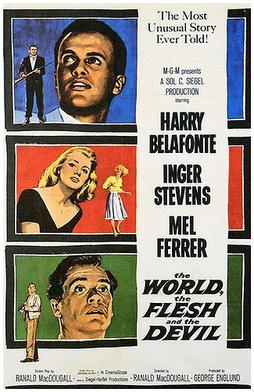
Anti-miscegenation laws were still on the books in southern states until 1967. However, even when certain relationships were illegal, science fiction authors used them to demonstrate either the scope of the catastrophic fall of humanity, or the blinding pace of "otherness" of the future. The 1959 film, The World, the Flesh and the Devil, explores this premise with  a sort of rye humor one expects from a sci-fi film starring Harry Belafonte.  In it, Belafonte plays Ralph an educated, technical savvy individual who spends most of his post-apocalyptic free time avoiding the sexual advances of Inger Stevens [ed: What ?]. The movie sets the audience up with an "unusual" tale, but keeps the action from getting into pearl clutching territory (remember it is 1959).

By the 1970's, audiences were more tolerant of interactive relationships taking the next step. As shown in the opening image, 1971's The Omega Man (the second remake of I Am Legend)  features Heston and Rosalind Cash in all their leisure suit meets Afro in plague ravaged mutant Los Angeles {Ed - this differs from present day Los Angeles how ?] Unlike Belafonte, Heston has no qualms about romantic entanglements that might make some uncomfortable.

Even in present day media (see current season of Walking Dead, and past episodes of Firefly, Caprica, BattleStar Galactia, Star Trek,  Terra Nova,  the remake of I am Legend, Hancock, etc., ( Ed. we could have a separate discussion on Wil Smith and depictions of his love interests )  interracial relationships are sometimes used as a short hand to demonstrate the dire straits of humanity or a wild future where the uncommon is common.

The reason that this trope work[ed] is because historically, interracial relationships were unrecognized, if more common than conventional wisdom dictated. By showing "uncommon pairings" the world builder is telling us something about the underlying social strata in which the work takes place. Humans are social animals, and prize companionship over all else. These relationships are meant, in part, to tell us that human nature is to seek companionship, even in the face of societal (or because of societal) collapse.

However , it also takes the subversive position that social structure, miscegenation laws and the like are not natural to human condition. They are artificial constructs that sit on top of a simpler form of society, one of individual choice and preference, of a freedom of relationships which is not possible while the trains run and the Man punches your time card. The relationships in these pieces of fiction are simplified, there are no walks past disapproving peers, awkward family dinners; but they are also presented as partnerships. Survivors, regardless of social strata and ethnicity, make a good fit.

As time and progress marches on, the rate of interracial relationships are on a steady rise. What does that mean for this short hand, this short cut, when these types of relationships are common. I would love to see this trope get taken in different directions. Humanity is varied, so should our future disastrous relationships. With a Bi-racial president and a biracial family in the Mayor's residence of the largest city on the continent, it is time we updated what the future looks like.

Wednesday, October 23, 2013

Antagonist frequency in Fiction

During the discussion of high-quality and low quality fiction, an argument is usually made concerning antagonistic frequency rates. Simplified, this argument goes something like this:

Book proponent: "Sexy Vampires IV is the best Historical Slash-Vamp Dom Fiction out there!" 

Book Detractor: "Man! Slash-Vamp fiction is totally played, everyone is doing that these days." 

Insert you proposed antagonist into that conversation and you will get someone who will tell you that the Genre is over done, played out, or no longer interesting.  Additionally, any conversation of reasonable length with agents, publishers and marketers will eventually result in them telling you which particular genera of fiction they are tired of seeing.

The rise of self-publishing has pushed this situation into overdrive. Where originally there were maybe a half-dozen entries in a particular genera per year from major and minor publishers, you now have hundreds, if not thousands, of attempts to tell a particular story. But does that mean that you should abandon your attempt at telling the greatest Vampire Zombie Love Story?

What is lacking is historical perspective. Google's Ngram viewer gives some imperfect, but interesting, historical context to the antagonistic frequency debate.

As shown above, the frequency of various antagonist (this is current through 2009) in English fiction is charted. Generally, in current fiction debates, Vampires and Zombies are singled out as being over-done in terms of genera.  However, Aliens as a concept has held a pretty consistent lead, and it currently, even though there has been some decline, is at a historically above average position.  Interestingly, the concept of plagues, which can be related to Zombies, has been on a historical downward slop ever since a peak some time in the 1810's.

Robots, the term being unknown prior to Capek's seminal work, takes off after the publication of R.U.R., and hits a peak in the mid eighties (think original Terminator, transformers, etc.) that surpasses the popularity of vampires today. Sadly, we appear to be living in a world of "Peak Robot", due possibility in part to the rise of non-fictional robots in our everyday lives (e.g murderous drones, vacuum cleaners).

As a point of comparison, the next chart looks at the frequency of some events in fiction (we use aliens as the cross reference to the above chart)


As shown, the concept of the Rapture is down from its historical heights, but has recently made a resurgence, and appears to be on track to overtake Aliens in frequency.  However, from a Genera standpoint, no one argues if Rapture based fiction has reached "peak rapture". [ed. This chart only goes to 2009, if goes to 2012, it might be that there was a serious crash after the Mayan Calendar failed to turn us into orbs of pure something.]

The point here is that antagonist come and go, but without data, it is difficult to determine if present, or short term historical bias is altering peoples' perception of what is or is not a popular genera. Having some data is always a good rule of thumb changing behavior, concepts or positions.

Monday, September 23, 2013

Vampires are terrible

By the title of this post you can probably guess that that I am about to rant about sparkly vampires or loving vampires or generally any sort of vampire that would not feature predominantly as a villain in a Blade reboot (ed:  Blade Reboot? awesome sauce!). 

For the most part, you would be wrong. There is nothing wrong with twinkle vampires, sensitive vampires, or any other form of vampire-based fiction that explores wish fulfillment.  True, there is a lot of "my rich boyfriend is a secret badass", to a lot of modern vampire stories. As a result, people think the genera is over. "No more vampire stories!" people (namely book agents) cry!

There is nothing wrong with the genera. It might just be that the current story slate, ( i.e., rich boyfriend), needs to be investigated further. Economic theory says that if nothing else, most vampires should be at least affluent, if not down right uber-wealthy. Figure out a story that explains how your sexy vampire got his cash, and you might have a new angle on an old idea.

ISSUE 1: Vampires are (or should be) rich.

Vampires, without direct violence, can be expected to live anywhere from "A Very Long Time" to "Infinity." While that sounds great in and of itself, it is really great from an economic stand point. Compound interest is wonderful, as is, the stock market. Most vampires lack the need of actual economic inputs (read: food, clothing, shelter, sleep...air). As such, their actual cash outlays are minimal to non-existent. If they possess special powers, such as super speed or flight, then generally they have zero to minimal transportation costs. Think about the cost of an average transatlantic flight. Vampires pocket that for fancy hotels and ebony-wood coffins.

However, most vampires lack a normal occupation (with the exception of the one that was a rock star and that other one that ran a medical clinic in Washington State) and hence a steady income. However, one assumes if you rob your food source (i.e. people); you can make do. In fact, after a few years you probably have acquired some sizable assets.

Now, let's assume that your vampire boyfriend is nice and does not commit regular robbery/homicides every other lunch period. However, lets also not assume that he hails from some degenerate landed gentry or b) employs some sort of glamer on people, thereby hypnotizing them into giving them money.  Assuming he was, in his mortal incarnation, middle class; then by investing some portion of his money (which he really does not need)  in the sock market (say in General Electric stock in 1915) and living solely off the dividends (or reinvestment or diversifying in times of economic struggle), then by the time he hit the 90's tech bubble he would be a millionaire several times over. By not touching the principal, each vampire more than 50 or 60 years old should have a sizable amount of the worlds money locked up in various modern, well-appointed, seaside homes.

So any story that I encounter that does not explain why a) the vampire is or isn't rich; or b) lacks the assistance of a good financial adviser; should be suspect to the tiny Alan Greenspan that lurks within us. Money is part of the world, an essential part. Relative wealth, and how it was acquired, is a necessary component of any fleshed out character.

ISSUE 2: Vampires Are Bad at Science.

Vampires, as stated above, are considerably long lived. Generally, society mourns the loss of great intellects, from Newton to Einstein. One would think that vampires would scoop up these top notch scientist at the bargain basement price of "almost dead".  Why stop there? Why not selectively "convert" the top graduate(s) of  highly prestigious technical universities.

Truth be told, there should be vampire covens of geniuses. Each one, a collection of immortals sitting around creating fantastic works of art, literature, and science. One should assume that the internally produced vampire literature is significantly superior to human literature. Most vampire stories take the position that only good looking people, of an artistic bent, become vampires (see rock star). However, rarely do we get a story about the great and fabulous vampire museums featuring the "post-turned" works of Picasso, Muro et. al.

Most vampires stories paint the species at a significant technological and ecological disadvantage relative to humans. Vampires rely on a slowly reproducing natural resource that is subject to plagues, pandemics, endemic violence, and natural or cosmic disasters. Farmers wouldn't tolerate the level of uncertainty in the long term viability of their stock. Likewise, surveillance technology, networked infrastructure, high-capacity ammunition, and directed energy weapons all level the playing field against the natural gifts of the supernatural. Vampires should be concerned about the technological prowess of their food-stuff in the same way we would be worried if we started seeing pigs collaborating with cows to build catapults.

ISSUE 3: Vampires lack vision.

With unlimited life spans and budgets, individual vampires should be able to privately fund all manner of Manhattan Project-style endeavors.

For example, given their superhuman abilities, vampires are almost specifically designed for Deep Ocean and Deep Space exploration.

A round trip to Proxima Centuri, at 1/10 the speed of light (which is all we could ever be capable of with modern technology) would take 80 years. This is seen as a barrier for humans, but with a steady supply of cryogenically frozen blood (not to mention "Deep Vampire Sleep", it would be a cake walk for vampires.

Assuming ambitions closer to home, one would expect that at least some vampires use their vast wealth and time horizons to devise counter-measures to human extinction (since one prefaces the other), and are ready to deploy them at a moment's notice.

At the very least, you would assume that Vampires operate technology that is several generations ahead of our own. Faster computers, smaller devices, robots . (ed - see Vampire Hunter D series for technologically advanced vampires).

The point here is to note that "Vampire" as a genera, just like any other genera, has room for interpretation or reinvention. Just because there have been a spate of successful, "Vampires are my Boyfriend", books doesn't mean that every story that could be written about them has been written. Now, a book on Vampire Economics might not get turned into a best selling novel series, but it would definitely set the author apart.

@Moorsgate
www.moorsgatemedia.blogspot.com

Wednesday, August 28, 2013

Implicit Knowledge

(c) Deltron
The concept of using implicit knowledge in works of art is nothing new. As early as Herodotus, authors and story tellers were incorporating the implicit knowledge to make allusions, references and comparisons for their audiences. 

The same is true of the arts in the modern era. Books, movies, plays and music all trade in common cultural understandings. If a movie about teen love makes a thin reference to Romeo, the audience gets it. It assumed, and rightly so, that anyone consuming a love story is at least casually familiar with Shakespeare's most famous (currently) work. 

What recently struck me was how a large corpus of Science Fiction knowledge is implicit in modern Hip-Hop. I say appreciation because, as I will show, the reference are not derogatory to Science fiction, instead, they are celebratory, positive.  

Any review of rap lyrics will no doubt point out reams of references to movies and cartoons. However, I want to take a fairly recent, highly publicized example, a take a look at the implicit knowledge being assumed. 

Kendrick Lamar (on the now forgotten Big Sean Song 'Control' ) drops this verse:


I've seen niggas transform like villain Decepticons 

The implicit knowledge, and the key to understanding the word-play, is that Decepticons are a race of highly advanced transforming machines.  There is no explanation in the verse regarding Decepticons, or there eternal enemies the Autobots.  It is taken for granted that you a) know what he is referring, and b) appreciate the context in which he is using the reference.

Note: It is often said that people of a certain age and bent fail to appreciate the poetry in Rap, and just see it as wandering lyrical noise. Part of that failure in appreciation is no doubt the result of a lack of implicit knowledge on the part of the consumer. The same could be said for the amount of implicit knowledge bound in a country song that make references to Dale Jr. (ed. you can look that up yourselves).

Kendrick's verse on Control generated a lot of soul searching (or teeth gnashing) depending on who was referenced. We won't go into the other points of contention on the verse, but Twitter is your friend. 

After this verse came out, there were dozens of "response" verses that sought to combat Kendrick's characterization of the entire rap field as "soft" ; with the exception of a chosen few.  

The responses ranged the spectrum from poorly executed, to quite well done. One of the best, also happens to contain a sizable portion of implicit science fiction knowledge. 

Joell Ortiz responded to Kendrick with lyrics that included these lines: 


And never turn, I'm immune to these rappers y'all calling sick.

Currently, apocalyptic fiction is all the rage, be it zombies, plagues, or un-characterized 'other'. The implicit knowledge here is related to zombies as opposed to giant transforming robots. Within these lyrics is the implicit knowledge of what a zombie is and how to dispatch one (hint - splitting a zombie's brain-case).  

Also referenced is the wildly successful TV show "The Walking Dead' (future AMC endorsement?) is a study of man's fight against inhumanity...and Zombies. So too, alludes Joell, that he faces existential struggles against being a 'monster' (Mr. Hyde nee Frankenstein?).  Additionally, the lyrics assume you know and understand that zombies transmit or "turn" others into zombies by bites (generally, although some works would add any fluid transmission). Joell would like you to know that he is immune to this particular disease vector. 

After a few bars related to various West Cost Gang issues, Joel returns to the Sci-fi theme and drops this long sequence that is stuffed with both allusions to Kendrick's verse, but also to popular movie starring Will Smith. 


First off, Hasbro really needs to endorse more rappers, since this was the second reference to its IP by a rapper in a 24 hour period.  Secondly, there is implicit knowledge that not only does Joell's audience know what Independence Day refers, but that they are aware of the Heroic / Tragic fate of Randy Quaid. 

What's the point here? The point is that science fiction (and to a lesser extent Fantasy) have a place in the implicit cultural understandings of an art form that is decidedly "un-nerdy." Sci-fi, fantasy and other types of exploratory fiction have, through no concerted effort, penetrated into the consciousness of rappers and their audiences. 

So, before you listen to someone telling you there is no market in sci-fi directed to people who also like Rap (i.e. young, urban youth) tell them to listen to some rap and see if they can spot the sci-fi.
  

Wednesday, August 7, 2013

Obligations of the Creator

The people that contribute to Moorsgate Media in general, and I particular, think a lot about world building. Be it the setting of rules for a role playing game, the types of magic and monsters that should lurk in the corners of Urban Fantasy, or the types of FTL technologies available to any one race. 

However, there are other considerations that always come up in the scope of world building. What, we wonder, is an author's or designer's obligation to his audience?

Is the writer of a Zombie Apocalypse story required to have his scrappy band of survivors represent, and represent well, every strip and strain of humanity. If he doesn't, has he committed some cardinal sin of fiction? Is a game designer's option to have her female character be a lesbian, mean that she is implicitly writing off the hetrosexual gaming population? Is the reverse true? Is a Gay Male hero saving his boyfriend a "damsel in distress" trope? If not, why? 

Recently, GRRM, author of the widely successful Song of Fire and Ice series ( and TV Show under the Game of Thrones label) has come into some criticism for both the "ethnic" casting of certain characters, and his depictions of whole (made up, but historically analogous) regions. Anyone interested in the specifics of those arguments can find them on the intertubes. 

Similarly, feminist critic Anita Sarkeesian, and others, go into great detail the way that gender is construed in mainstream and indie video games.  Both sets of criticisms are valid and worth your time. However, there is an uncomfortable vagueness of concern that lurks at the core of the criticism. 

Obligation. 

What is the author's obligation. Is a straight, white male obligated to create "others" for the benefit of his audience? Do we want him to? Do we want positive role models for underrepresented peoples to be crafted by the over-represented? If a black lesbian writes a novel, is she obligated to have a positive portrayal of straight white men? Should she? Is the opposite always true?

This is not to say that there is an equivalence between those authors whose trade is tropes and stereotypes and those whose aren't, but the question needs to be asked. Who is the arbitrator of your work?  If the market is, then the market decides if a story-line is a trope, or a re-invention, sufficiently diverse or not. If it is society, then society should be able to produce enough voices that one successful GRRM is countered by other depictions of POC in a fantasy setting. 

If that's not the case, and I think any cursory reading of widely successful new IP in the sci-fi and fantasy space says its not. Then we have to ask why? Where are the sweeping Tolkien-esq epics featuring POC characters? Where are the gripping video-games with all female-leads? Do the underrepresented have an obligation to create for themselves, as well as criticize.