Wednesday, January 1, 2014

Modern Rosetta Stones

The resetting of the yearly clock (regardless of the particular clock with which you subscribe) is a great time to evaluate the course of history and how modern society fits into that unbroken chain.

The original Rosetta Stone was created in 196 BC to memorialize a debt relief program instituted by the Ptolemy Kings of Egypt.


(The Ptolemy Kings were not Egyptian, but Macedonian. They were the descendants of Ptolemy who was one of Alexander the Great's generals, Cleopatra would be the last of his line).

The practice of erecting large documents stones was a ancient tradition in the second century BC. There is archaeological evidence that "stele" had been erected discussing tax relief for at least 2000 years prior, at the dawn of the Old Kingdom.

Until the discovery of the Rosetta Stone, researchers had no way of understanding the content of Egyptian hieroglyphics. The Rosetta Stone provides nearly identical statements in Egyptian hieroglyphics, demotic script (a kind of Egyptian document script) and important ancient Greek.  From ancient Greek, Roman scholars transcribed many ancient philosophies and histories. These Latin and Greek texts were then translated by Arabic scholars and eventually were deposited into the libraries of the great European institutions of higher learning.   Thus, a writing system 4000 years old, with no living practitioners was resurrected.

Without this stele and others of its kind, we would never have been able to decipher, as quickly or as easily, the complex Egyptian hieroglyphic system.

Of course, one's thoughts necessarily turn to our own languages and how easy or difficult, it would be
revive our own written language 4000 years in the future. We make few, if any, multilingual stone monuments.

One exception is the Georgia Guide Stones. This immense granite block, commissioned by unnamed individuals, contains the same inscription written in 8 different languages, including English, Chinese, and Spanish - the most common languages used in the modern world.

However, one stone structure in the Georgia woods is not something that humanity should rely on to ensure that the vast corpus of accumulated knowledge written in modern English is preserved for generations.  Researchers from the Principality of Zhang-Sanchez in the year 6014 might not have access to this single granite monument. (Why? Because Aliens stole all our granite in the great Granite Caper of 5679 /Global Warming /Zombies / Fear of stones?). 

What people of the future will have access to is our trash. Our rubbish might make all the difference in deciphering any number of languages. For example, the picture below was taken of a crib being thrown out in NYC. Where it will end up is anyone's guess. However, within the steel and plastic confines, is a plastic sheet written in Spanish, English and French. Carted off and buried in a landfill it will wait with its precious knowledge codex until someone digs it up, and realizes ancient man (us) had instructions for everything, including how babies should sleep.


If you have examples of modern day Rosetta stones, leave them in the comments.

Moorsgate Media (c) 2014.


Wednesday, December 25, 2013

Low Tech Arcology for the long haul: sustainable architecture

From the works of Paolo Soleri

Previously we took a look at urban-steading as an alternative to bugging out in a civilization collapsing event (read : zombie apocalypse).

Whether you are pro or con on the notion of urban survival, everyone recognizes that rural, low population areas are the best when it comes to riding out some sort of catastrophe.

A lot of video and print(digital or traditional) has been spent discussing the value of compound A vs bunker B. While those architectural forms are well suited to immediate defense, no one should be contemplating living in a bunker for the rest of their lives, or their grandchildrens'. 


Thus the question becomes, what modal of living is well suited for reforming some semblance of community? Not just a community of survivalist, digging in their heels at the end of history, but what is the modal for a new history, for the translation period. The period when the horror of the now, becomes the dim oral history of the future.

In terms of societal arrangement it should be uncontroversial to posit that any post disaster political organization will have strong Communitarian features (I.e. not official socialism, in part, because money would be largely irrelevant).

These Communitarian features will have a direct impact on the architecture which results. In the same way that totalitarianism results in hilariously strident neoclassical architecture (see Nazis, all). Communitarian principals in the name of survival will necessitate an architecture form which prioritizes collective survival.


For example, medieval architecture, castles, cathedrals, monasteries, all form the basis of defensive architecture. However these structures were built with the same intended time scale as modern day Preppers' bunkers and compounds. They are temporary reprieves from the temporary dangers of the world. They are not long term communities built with an eye to sustainability AND growth.

However, there is an architectural mode well suited for this type of circumstance; the Arcology.  One of the problems with co-opting this architectural form is that Arcology construction is generally considered monumental. It would be hard to marshal the resources to build an Arcology in normal times, it would be reckless to consider it after the fall of modern society. 

However, not all forms of arcologies are necessarily of the type and variety requiring a high-tech infrastructure.

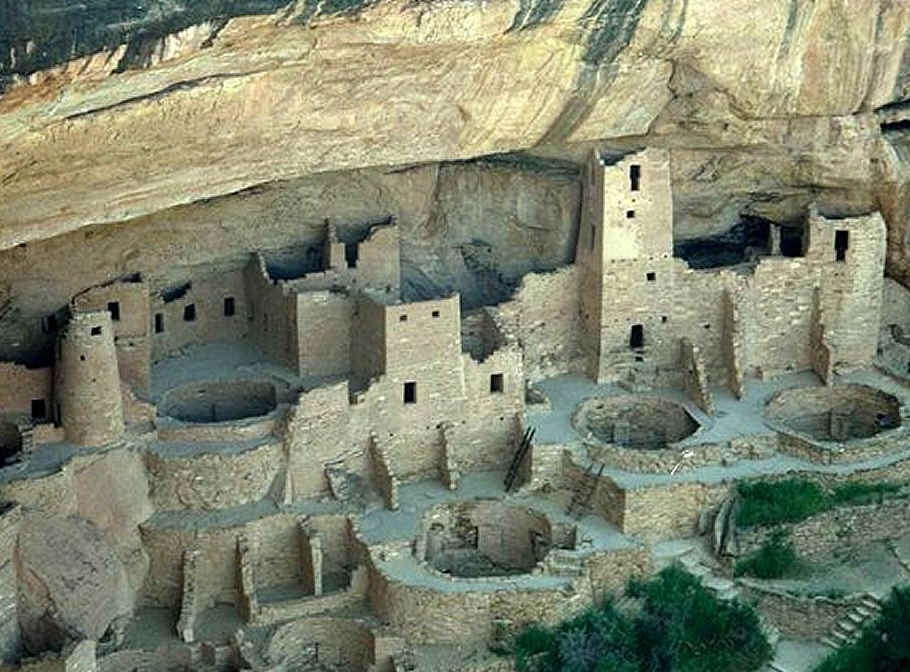
 Nearly 1000 years ago, peoples native to the South Western United States made magnificent multi-modal structures that provided all the necessary functions of community, within a tight footprint. The Ancient Pueblo Peoples built vast, pre-planed structures that were the largest structures built in North America until the 19th Century.  

With simple tools and materials (sandstone and wood) the Anasazi were able to produce 900 room mega structures complete with living quarters, religious meeting places and massive self-contained urban habitats. 


There is no technical reason why a determined community, say several hundred in size, could not replicate the architecture of the Anasazi.  In fact, given the benefits of modern knowledge stores, the planning, construction and maintenance of a basic arcology should be within the capabilities of most groups. Combined with modern technology (cameras, computers, sensors), these low-tech arcology platforms could form the basic unit of safe defensible community.


 Solar power generation, reactors, and light manufacturing could all be housed within the structure, giving rise not only to defense, but community level sustainability. 

Even without a massive catastrophe, the future of society might trend towards low-tech arcologies as the basic form of sustainable community. Increasing resource scarcity, combined with natural disasters which disrupt the normal flow of government services, could lead for like-minded communities to build low- and mid- tech arcologies to weather what the future holds, together.  
  

Wednesday, December 18, 2013

A yuletide collection of postcards featuring Santa's goat-man helper

For the ill-informed, Krampus is a beast like creature that features heavily in winter festivals of Alpine Countries (Germany, Austria, Hungry etc). [Ed. If you watch Grimm or American Dad, or The Venture Bros., you would be tacitly aware of the concept].

Krampus originally began as part of Germanic pre-christian rituals. However, after the Roman Church converted the Germanic peoples to Christianity, Krampus was paired with Old St. Nick.  As St. Nick's companion, Krampus is charged with beating, kidnapping, consuming, transporting to Hell, and otherwise making naughty children's lives around Christmas a terrifying game of waiting until this cloven footed monster would end them.

Even with this tacit blessing by the Church, there were many attempts in Austria and Germany to stamp out the practice of giving children PTSD around Christmas time. One assumes that many a "home-alone" scenario played itself out in the minds of young Gustav and Heidi deep in the Bavarian Alps. A dark winter night, a knock at the door. Screams! It must have been like a second bite at the Halloween apple for pranksters of the 17th Century.

Over time, modern sensibilities about telling children that a demonic goat-man was going to kill them transformed Krampus into a demonic goat-man who gives out coal and bundles of kindling to bad kids. In the Germanic tradition there is always a terrifying demonic half-goat man.

Krampus and St. Nick share the Christmas naughty / nice list, dividing the work like only a mildly socialist country can. St. Nick only gives presents to good kids. He doesn't truck in coal delivery. That is Krmapus's bag.

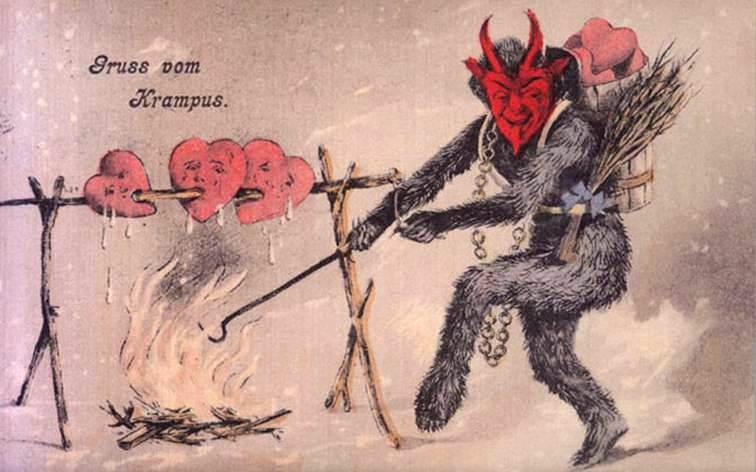
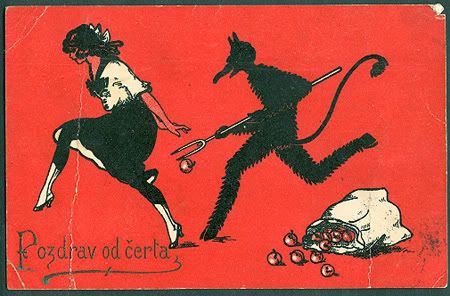
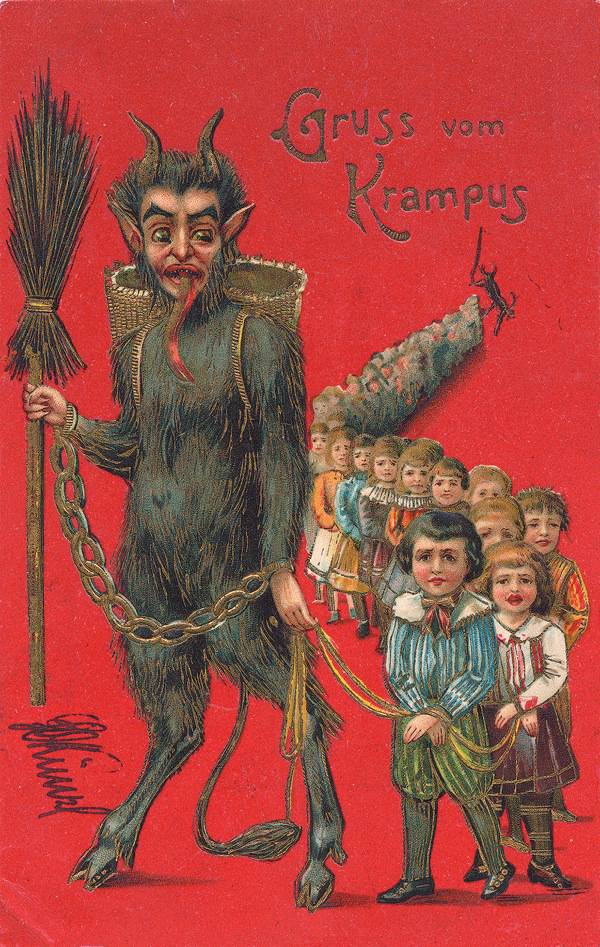
As with all things Christmas, people have been making some money off of Krampus for centuries. One of the earliest forms, was Krampus greeting cards, distributed since the 19th century. This gives us a great visual record for the evolution of the concept over the last 150 years.

All of this has got us thinking about the Antagonist frequency of a earlier blog post. The universe of potential antagonist in fiction is massive. However, western literature tends to stick close to home regarding supernatural creatures. For every story out in the world about Krampus, there are 1000x more stories about Vampires, Zombies or Aliens.

One partial theory for this is that fiction is really about us, our society. Zombies and Alien invasions and Sparkly Vampire Boyfriends are telling us something about our culture and our society. They are a mirror of what we fear or desire at a subconscious level (immortality, a fresh start to civilization, a cool trench coat).

There was a time and place where Krampus spoke to people, to their society in a very real way. It seams silly now, but they took it quite seriously, otherwise it wouldn't have endured for millennium. It is just that our society doesn't fear the same things as society that came up with Krampus. Perhaps, we have forgotten to be afraid of something.

Great fiction not only explains us to ourselves, but sometimes points out fears we didn't realize we had.

Below is a smattering of the best cards.


Roasting hearts instead of Chestnuts is a new tradition.

It should go without saying that Krampus has an eye for the ladies.


Abandon all hope, rosy faced children of the world. 

Saturday, December 7, 2013

Urban planing as zombie defense


On a recent trip to Japan, I had the opportunity to stroll through some of Tokyo's residential districts. Through a combination of war, natural disasters and economics, modem Tokyo is a sprawling high tech megalopolis. However, within this city of skyscrapers and gleaming trains, vestiges of the older city remain.

Many temples, shrines and even single family houses in Tokyo take the form of small walled compounds. From a functional standpoint these walls are not really designed to deter a determined intruder, but they generally provide the boundaries of the particular homestead or site of importance.

 Importantly, whole communities exist with within arms length of these compounds and one another. Sometimes, the less then 7 feet separate one walled home compound from another.  

While the gate in the picture is not likely stopping a contingent of alien invaders, it might prevent the wandering, shuffling type of zombie featured in most fiction.

All of this leads this leads to an interesting thought experiment about the suitability of different cultural architectural styles to resist an encroaching disaster.

American architectural preferences led to wide suburban sprawl. Large homes are placed on large tracts of land, usually without significant walls or fences encircling the property. The same is true from churches is most of the western world.  Americans, it is often remarked, like their space. However this abundance might work to their detriment.

Isolated homesteads can be overrun or worse, subject to siege. Suburban occupants could easily be cut off from resources, eventually running dangerously close to starvation while an ever growing inhuman horde gathers outside. You can not eat bullets and gold bars. Eventually, by desperate act or carelessness, the hordes will eventually find entry through a broken window or a battered screen door.

In contrast, it is easy to imagine a network of makeshift bridges spanning the short distances between Japanese homesteads, temples and shrines. Resources and skills sets could be combined to colonize abandoned neighborhood homes. Eventually a network of homes, roof-top gardens, protected construction sites, fenced athletic fields, and sundry stores could be maintained, cultivated.
Eventually a new city would build itself over the infested ruins of the old, spreading itself out along ribbons of past density. The inhabitants of this new city would use and adapt the machinery of inherited urbanity; the sewers, canals, underground infrastructure, to short circuit the dangers and maintain living standards.
This new city and others like it would resemble Venetian cities crafted over zombie seas.

Most apocalyptic fiction focuses on a return to wilderness, man as an inherently rural being. This, I think, is a uniquely American fantasy. However,  it might be that cities, as they always have, retain their role as the epicenters of human civilization after the fall of man.

Moorsgate Media 

Monday, December 2, 2013

The Mechanics of World Building

One of the things that stands out as the deliminator between great fiction and mediocre fiction is the ability to build credible worlds.

 Building a credible world is more than a sweet premise, like say Vampire Ninjas who wear awesome reflective ninja suits (Ed. Sparkly Ninja Vampire Boyfriend: coming soon from Moorsgate Media).  A credible world starts from a reasonable (or not so) premise, and then builds a realistic world around that premise.  Credibility in world building comes from making the incredible credible.
 If upon reading your story or your game plot summary, your testers keep telling you "I don't understand why Ninja Vampire Lestapolizes would rebel against the Triamphumphrate of Zoldan?" then you have a credibility problem.

However, solutions to the credibility problem are easier than you think. One of the reasons that A Song of Fire and Ice is so popular is that the author has taken a fairly fantastic premise and built a credible world around that premise. Sure, dragons and ice zombies are fairly fantastic notions. However, backstabbing alliances of rich people, wars over rightful succession, and the obligations of a liberating power, are all credible everyday topics. GRRM has explained that most of his source material comes from The War of the Roses,  British civil war that took place in the 15th century. GRRM added fantastical elements to a historically supported story and wound up with a massive hit that has spawned a hit TV show and a legion of fans this is giving Tolkien a run for his money.

While not everyone's story will take off like GRRM's, there is no reason to not explore the possibility of using a historical platform to tell an ahistorical story. Human history, written and oral, is full of tales of heroes and villains and political machinations.  A story can not be hurt by researching a historical event that has parallels to the world you are building.

 Writing a zombie apocalypse story? Check our the Black Death for inspiration. What did people do when faced with the seemingly realistic proposition of the end of the world? Alien invasion? Look to the Macaque, the Sioux, the Taliban (depeding on your character's POV).

The world building process does not have to take place in a vacuum. Science Fiction is built on historical allegories, there is no reason to abandon that path. If you are finding that your world isn't credible, motivations are murky, check to history, and it might provide the future.

Monday, November 11, 2013

Inter-racial relationships mean disaster!

The recent election for mayor of New York City was remarkable for a number of reasons. For one, it was an election where the right to "Sext" became a front page issue. More importantly, it was an election where one candidate was running for mayor is married to a woman of a different race, and no one made a big deal about that relationship. In fact, most political observers believe that the Mayor-Elect owes much of his success TO his bi-racial family.

One of the ways that science fiction has sought to portray "the future" is through the use of non-typical character positions and relationships. This is a polite way of saying "you know it is the future because of X", where X could be anything that would't happen today ( i.e. Black President, to well....female president). Basically, any time (prior to 2008 ) you saw a non-white, non-male president, chances were that you were dealing with some sort of speculative fiction. See Freeman, Morgan;

Another tip off to the fact that you were dealing with dire straits was the taboo of interracial relationships.

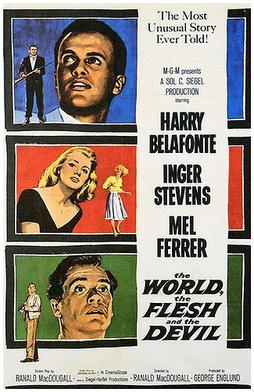
Anti-miscegenation laws were still on the books in southern states until 1967. However, even when certain relationships were illegal, science fiction authors used them to demonstrate either the scope of the catastrophic fall of humanity, or the blinding pace of "otherness" of the future. The 1959 film, The World, the Flesh and the Devil, explores this premise with  a sort of rye humor one expects from a sci-fi film starring Harry Belafonte.  In it, Belafonte plays Ralph an educated, technical savvy individual who spends most of his post-apocalyptic free time avoiding the sexual advances of Inger Stevens [ed: What ?]. The movie sets the audience up with an "unusual" tale, but keeps the action from getting into pearl clutching territory (remember it is 1959).

By the 1970's, audiences were more tolerant of interactive relationships taking the next step. As shown in the opening image, 1971's The Omega Man (the second remake of I Am Legend)  features Heston and Rosalind Cash in all their leisure suit meets Afro in plague ravaged mutant Los Angeles {Ed - this differs from present day Los Angeles how ?] Unlike Belafonte, Heston has no qualms about romantic entanglements that might make some uncomfortable.

Even in present day media (see current season of Walking Dead, and past episodes of Firefly, Caprica, BattleStar Galactia, Star Trek,  Terra Nova,  the remake of I am Legend, Hancock, etc., ( Ed. we could have a separate discussion on Wil Smith and depictions of his love interests )  interracial relationships are sometimes used as a short hand to demonstrate the dire straits of humanity or a wild future where the uncommon is common.

The reason that this trope work[ed] is because historically, interracial relationships were unrecognized, if more common than conventional wisdom dictated. By showing "uncommon pairings" the world builder is telling us something about the underlying social strata in which the work takes place. Humans are social animals, and prize companionship over all else. These relationships are meant, in part, to tell us that human nature is to seek companionship, even in the face of societal (or because of societal) collapse.

However , it also takes the subversive position that social structure, miscegenation laws and the like are not natural to human condition. They are artificial constructs that sit on top of a simpler form of society, one of individual choice and preference, of a freedom of relationships which is not possible while the trains run and the Man punches your time card. The relationships in these pieces of fiction are simplified, there are no walks past disapproving peers, awkward family dinners; but they are also presented as partnerships. Survivors, regardless of social strata and ethnicity, make a good fit.

As time and progress marches on, the rate of interracial relationships are on a steady rise. What does that mean for this short hand, this short cut, when these types of relationships are common. I would love to see this trope get taken in different directions. Humanity is varied, so should our future disastrous relationships. With a Bi-racial president and a biracial family in the Mayor's residence of the largest city on the continent, it is time we updated what the future looks like.

Wednesday, October 23, 2013

Antagonist frequency in Fiction

During the discussion of high-quality and low quality fiction, an argument is usually made concerning antagonistic frequency rates. Simplified, this argument goes something like this:

Book proponent: "Sexy Vampires IV is the best Historical Slash-Vamp Dom Fiction out there!" 

Book Detractor: "Man! Slash-Vamp fiction is totally played, everyone is doing that these days." 

Insert you proposed antagonist into that conversation and you will get someone who will tell you that the Genre is over done, played out, or no longer interesting.  Additionally, any conversation of reasonable length with agents, publishers and marketers will eventually result in them telling you which particular genera of fiction they are tired of seeing.

The rise of self-publishing has pushed this situation into overdrive. Where originally there were maybe a half-dozen entries in a particular genera per year from major and minor publishers, you now have hundreds, if not thousands, of attempts to tell a particular story. But does that mean that you should abandon your attempt at telling the greatest Vampire Zombie Love Story?

What is lacking is historical perspective. Google's Ngram viewer gives some imperfect, but interesting, historical context to the antagonistic frequency debate.

As shown above, the frequency of various antagonist (this is current through 2009) in English fiction is charted. Generally, in current fiction debates, Vampires and Zombies are singled out as being over-done in terms of genera.  However, Aliens as a concept has held a pretty consistent lead, and it currently, even though there has been some decline, is at a historically above average position.  Interestingly, the concept of plagues, which can be related to Zombies, has been on a historical downward slop ever since a peak some time in the 1810's.

Robots, the term being unknown prior to Capek's seminal work, takes off after the publication of R.U.R., and hits a peak in the mid eighties (think original Terminator, transformers, etc.) that surpasses the popularity of vampires today. Sadly, we appear to be living in a world of "Peak Robot", due possibility in part to the rise of non-fictional robots in our everyday lives (e.g murderous drones, vacuum cleaners).

As a point of comparison, the next chart looks at the frequency of some events in fiction (we use aliens as the cross reference to the above chart)


As shown, the concept of the Rapture is down from its historical heights, but has recently made a resurgence, and appears to be on track to overtake Aliens in frequency.  However, from a Genera standpoint, no one argues if Rapture based fiction has reached "peak rapture". [ed. This chart only goes to 2009, if goes to 2012, it might be that there was a serious crash after the Mayan Calendar failed to turn us into orbs of pure something.]

The point here is that antagonist come and go, but without data, it is difficult to determine if present, or short term historical bias is altering peoples' perception of what is or is not a popular genera. Having some data is always a good rule of thumb changing behavior, concepts or positions.